
The short version
For anyone who reads the last page of a mystery first:
A tarotscope works the way a tarot card does. Its symbols wake your intuition, and the more you know about a planet, the more there is to wake.
Every planet arrives as a visitor on a card and carries a Major of its own. The seven old planets also keep the thirty-six faces and play host there.
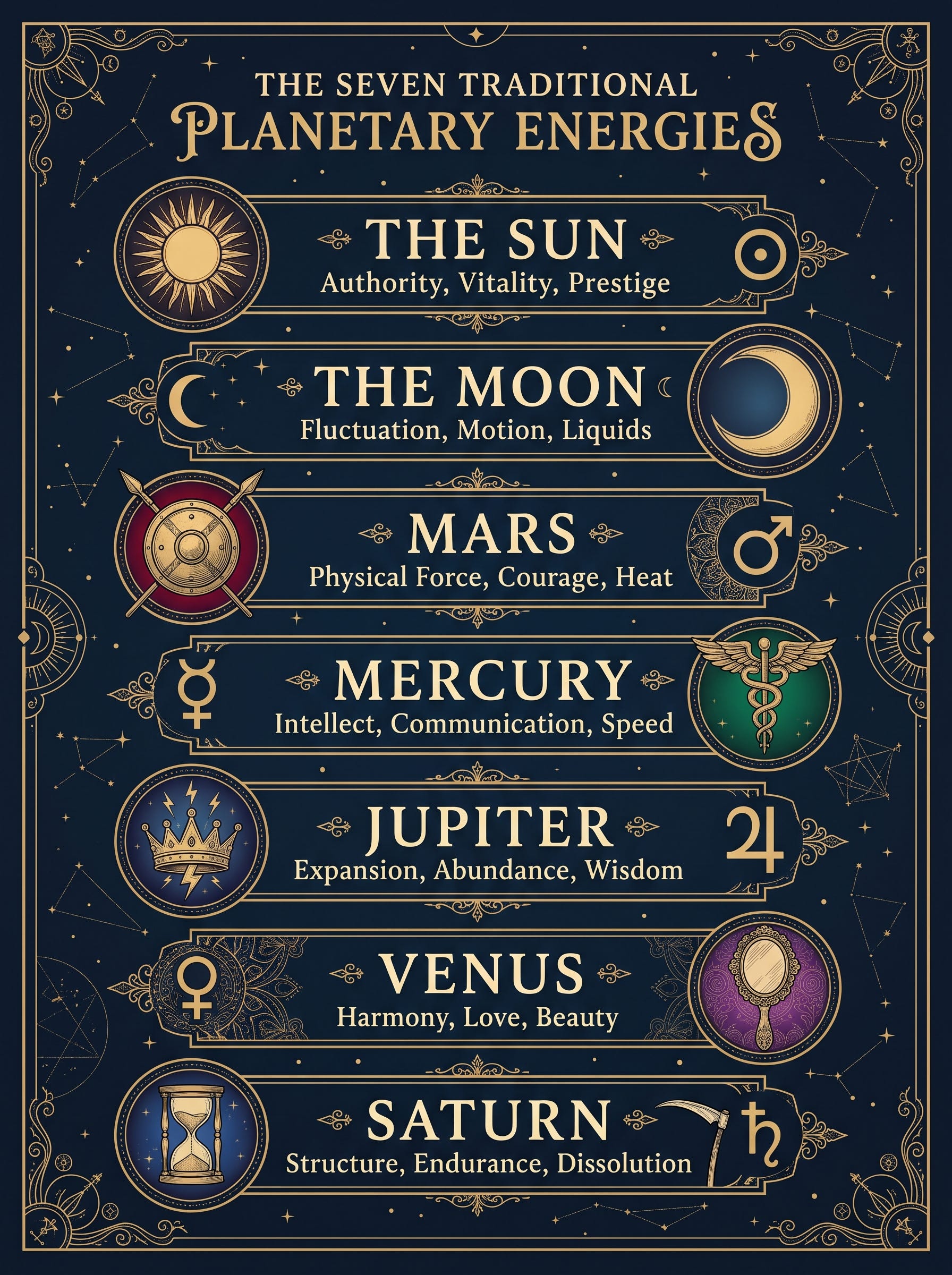
Each of the seven old planets has a day, a metal, a color, its gifts, its shadow, and a handful of symbols out in the world. The three newcomers have a card and a character of their own.
Moving forward, a planet gives its gifts. Retrograde, its card turns over and its shadow is the side to watch.
To use it, find the planet hosting the ten days, choose one of its symbols, and watch for it.
The seven old planets are also printed at the front of the 2027 almanac.
Why the planets are worth knowing
A tarot card does its work through its picture. You look at the Five of Pentacles, two figures in the snow passing a lit window, and something in you answers before you have remembered a single meaning from a book. The picture is the match, and your intuition is the candle.
A tarotscope works the same way. Every ten days, Mystical Fortunes Tarotscopes lays the planets on the cards of the days they are standing in, and I read the table for your sign.
My reading is one voice at that table. Yours is the other, and yours knows things about your week that I never will.
The planets are where your side of the reading finds its matches. Each one is a bundle of old symbols: a day of the week, a metal, a color, a few animals, trades, and places; one way of behaving when things go well, and another when they go badly.
Learn the bundle, and a line like “Mars is on the Five of Cups” opens up. You start to notice the red coat, the slammed door, the pepper in the soup, and the argument you nearly had on Tuesday. The symbols light, and your intuition does the rest.
The seven old planets come to us through a long line of hands: Ptolemy in Alexandria, Abu Ma’shar in Baghdad, Guido Bonatti in Italy, and William Lilly, who wrote the lot down in plain English in London in 1647.
Madame Fortuna kept them the way other women kept recipes, and she held that a reader who knew the seven by heart could read a tea towel. Three more have joined the table since Lilly’s day. Here are all ten, as we use them here.
How a planet arrives at the table
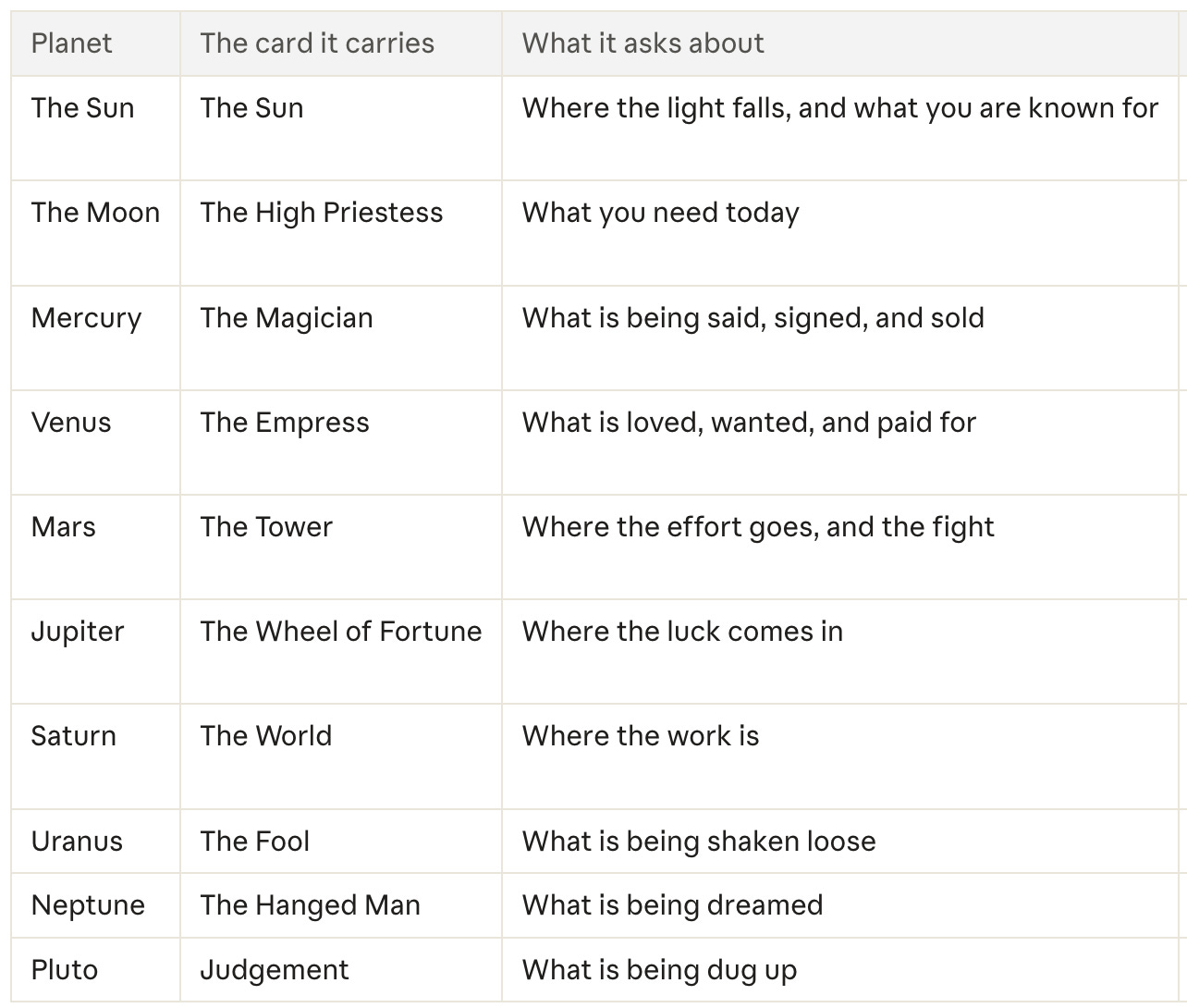
Every planet in an issue arrives as a visitor to a decan in the zodiac, standing on the card of the face it is crossing. It carries its own Major Arcana card, and it brings a question with it. The decan it stands on already has a keeper, one of the seven old planets, who plays host for those ten days.
A planet moving forward lays its card upright and gives its gifts freely. A planet gone retrograde turns its card over, and its shadow is the side to watch.
When the Sun walks onto a face, the keeper of that face sets the tone of the ten days. That planet is the first one to read up on.