

What a birthday board is
If you’ve been reading Mystical Fortunes Tarotscopes for a few issues, you already know the trick at its heart. The year is divided into thirty-six faces of ten days each, three to a sign, and every face has a card: the numbered cards of the minor arcana, Two through Ten, laid out around the wheel.
The faces are old. The Egyptians kept time by them, the Greeks gave them planets, and the Victorians, who could never leave anything alone, gave them cards.
The Sun walks over one card every ten days, and every other planet at its own pace.
The newsletter lays them out, the planet on the card of the face it is standing in, upright when it’s moving forward and turned over when it’s gone retrograde, and reads the board. That’s the whole system.
No houses, no aspects, no math past counting to thirty, and I say that as a woman who is not an astrologer, and have never claimed to be one.
Zodiac, yes, astrology, no.
Now put your finger on the day you were born. The planets were all standing somewhere that day too, every one of them on a card, and that board is yours for life.
Your birthday line in the newsletter already tells you one of its nine cards: the Sun’s.
For example, if you were born between the 12th and the 21st of November, the Sun was on the Seven of Cups, and that is the minor arcana card of your birth decan.
This article covers the other nine.
The Moon, which tells you what you need.
Mercury, how you think.
Venus, how you love.
Mars, how you fight.
Jupiter, where your luck comes in.
Saturn, where the work is.
And the three slow ones, Uranus, Neptune and Pluto, which you share with everyone born in your stretch of years, and which tell you what your generation was handed to sort out.
Madame Fortuna used to say that a birth chart is a letter you were given at the door and never opened, and that most people carry it around for years before they break the seal. This is the seal. It takes twenty minutes.
Get your planets
You need to know where the planets were on your birthday, and the easiest way is to let a free chart site do the arithmetic.
I use astro.com (Astrodienst in Switzerland), which has been doing this since before most of us had email, and astro-seek.com, which is a little friendlier to look at. Either one is fine. Both are free; neither needs an account for a basic chart, and both will try to sell you a report, which you may ignore with my blessing.
Type in your date of birth, your place of birth, and your time of birth if you have it. If you don’t have the time, type in noon, 12:00, and read the next section before you go any further. Then ask for the chart.
What comes back is a wheel with a great many lines on it, like a bicycle that has been in an argument, and you are going to ignore the wheel entirely.
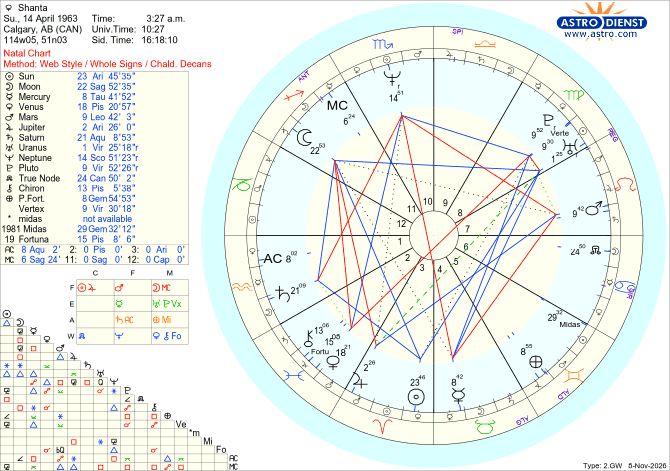
Beside it, or under it, is a small table, and the table is the whole prize. It lists the planets down the left, usually Sun, Moon, Mercury, Venus, Mars, Jupiter, Saturn, Uranus, Neptune, Pluto, and beside each one a sign and a degree. A line in that table reads something like this:
Sun 23°Ari 45'35"The 23 is the degree, the sign is Aries, and the 45’35” is minutes of arc, which you can wave off.
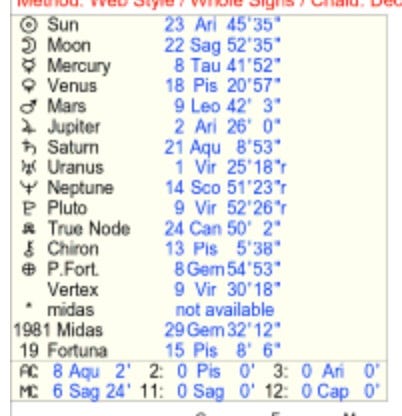
Some sites print the sign as a symbol; if a glyph is all you get, hover over it or look for a text version, because the sign name matters and the symbol is not worth learning for this. Some lines will also carry a small R, or Rx, or a backward-looking symbol, after the degree. That R matters very much, and it gets its own section below.
Write down ten lines: planet, degree, sign, and an R if there is one. That’s your raw material, and you can close the chart site now. Use a pencil if you don’t know your birth time; the Moon is about to make you change one line.
You don’t need to know anything else; not the ascendant or rising, the nodes, the houses, or any astrological knowledge at all. We are only using the zodiac signs and planet placements.
Everything else happens at the kitchen table.